The Robots Are Arriving as the Workers Leave
Every advanced economy is running out of workers on a schedule that was fixed decades ago. That cancels the AI displacement story in aggregate, leaves it untouched in composition, and turns the 2030s labor problem into a shortage in exactly the work AI does worst.
Contents
Forecasting is mostly the business of being wrong about uncertain things, which is why forecasters develop an unhealthy affection for the one variable that is not uncertain at all.
Demography is that variable. The people who will be of working age in 2045 have all been born. You can count them now. There is a margin of error, and it is trivial next to anything else in this blog: no breakthrough accelerates the birth rate of 2019, no crash revises it downward. Japan, Korea, Italy, Germany, and China already have shrinking workforces. Most of the rest of the advanced world is flat or propped up by immigration, fertility is below replacement in countries representing the large majority of world GDP, and, the part usually missed, it has fallen fastest in middle-income countries, which are aging before they got rich.
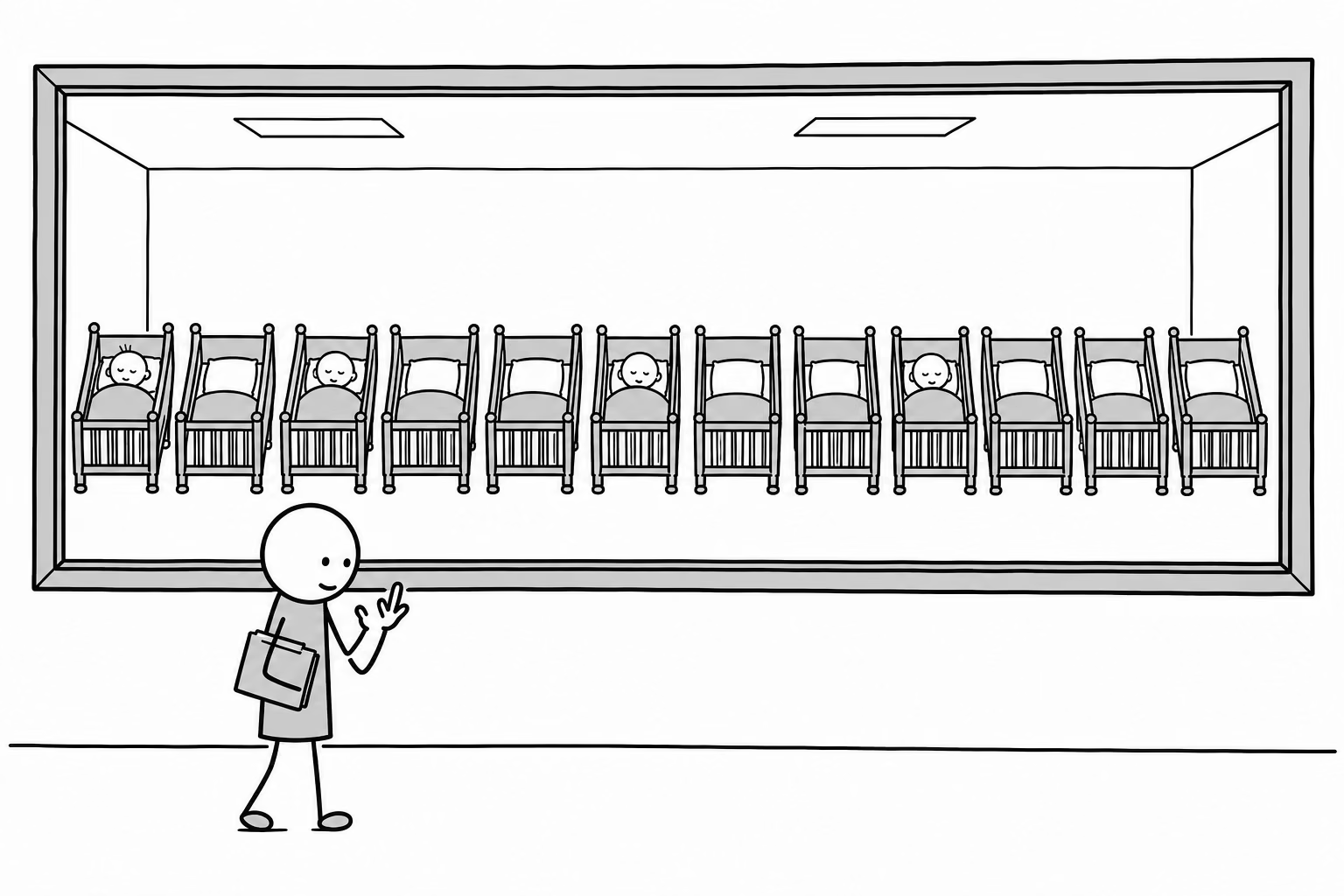
That nursery window is the entire dataset, and it is not a forecast. Every empty crib in the row is a 2045 vacancy that is already scheduled, and no policy reaches back to fill it.
Now put that beside everything this blog has said about labor. Sixteen posts about a technology that displaces workers, and the corpus admits the omission in one line: all of it has been written against the backdrop of economies that are running out of workers anyway.
This post is about what happens when you finally let the two biggest labor forces of the century into the same room. The answer is not that they cancel. It is more useful than that, and it is checkable.
They cancel in the aggregate and nowhere else#
Run the collision row by row, because the rows disagree.
| Demographics says | AI says | Net | |
|---|---|---|---|
| Aggregate labor, supply vs demand | Supply shrinking | Demand shrinking | Substantially offsetting |
| Cognitive, junior, routine roles | Fewer entrants | Much less demand | Still negative |
| Care, trades, physical, licensed | Sharply more demand | Barely touched | Strongly positive |
| The novice-to-expert pathway | Fewer novices | Fewer novice roles | Worse, not better |
Call the first row the Offset, and give it its due, because it defuses the century's most advertised catastrophe. The labor game's aggregate estimate, 10 to 14 million US job-equivalents over seven years, lands in an economy whose workforce is flattening and greying, and an economy like that absorbs displacement far more easily than a growing one. The corpus states the correction plainly: the aggregate displacement number should be read as an upper bound, and automation that substitutes for workers who were never going to exist is not displacement in any meaningful sense.
But look at the last row before relaxing, because it is this blog's oldest wound reopened from the other side. A shrinking workforce does nothing to restore the junior rung if the junior tasks are gone. It makes the arithmetic worse: a smaller entering cohort competing for a shrunken number of training positions produces the same missing-experts crisis of 2040 from both directions at once. The corpus calls this the cleanest example of its scoring discipline, and it is worth internalizing as a habit: the same fact revised the aggregate claim downward and left the compositional claim standing. Aggregate and composition are different objects. Score them separately, always.
Scarcity pulls the robots in#
The second consequence inverts the political story most commentary assumes, and there is a two-decade natural experiment to point at.
In a labor-abundant economy, automation is pushed onto a workforce that resists it, and the politics are ugly. In a labor-scarce economy, automation is pulled in by employers who cannot hire at any wage, and the politics mostly fail to materialize. Japan has run the experiment since the 2000s: high automation, low unemployment, minimal backlash. Nobody riots against the machine that fills a vacancy nobody applied for.

The shopkeeper in that drawing is not unemployed. They are asleep, which is a different condition, and the robot on the ladder is the reason the shop is still open at all. The street outside holds the entire protest movement: a cat.
Which reframes the great-power race in a way the bipolar page develops and almost no Western coverage does. China's workforce contraction is the largest anywhere in absolute terms, and China took 54% of global industrial-robot installations in 2024, 295,000 of 542,000 units, with domestic manufacturers outselling foreign suppliers at home for the first time (IFR World Robotics, 2025). The state treats automation explicitly as demographic policy. So the US races out of abundance of capital, and China races out of scarcity of workers, and the corpus's quiet judgment is that the second motive is the more durable one, because it does not depend on the return on investment staying high. A race run to replace workers who are already not there does not stop when the CFO gets nervous.
One more inversion, closer to home: the US, whose politics dominate every AI-and-labor debate, is the least representative case, being the one advanced economy with a still-growing workforce. The displacement anxiety that saturates American coverage is being generalized from the country where it applies most and exported to countries where it applies least.
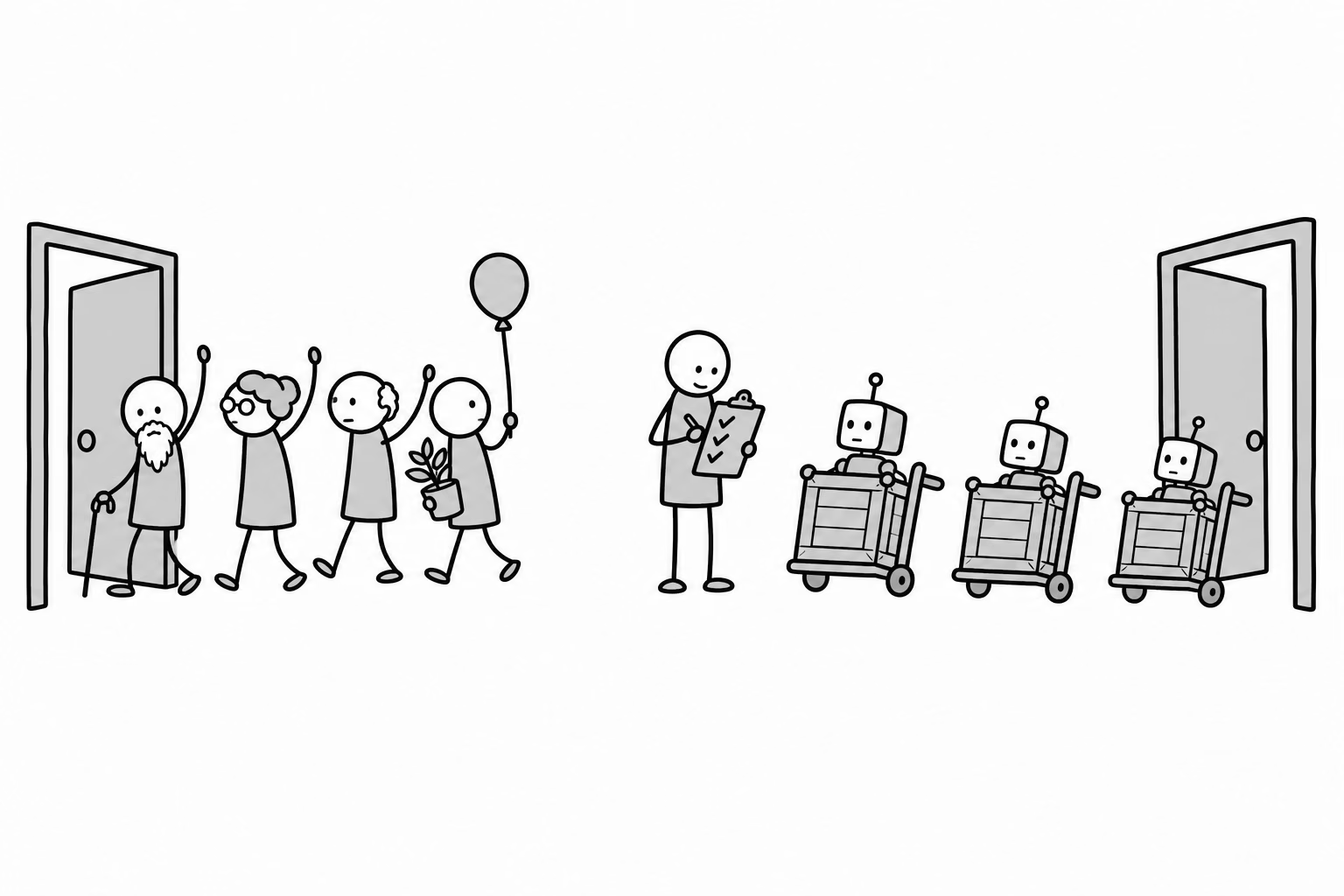
That is the 2030s labor market in one hallway: the retirement party heading out one door at a fixed, long-scheduled rate, the crates arriving through the other, and the manager holding a clipboard that never balanced anyway. The drawing's point is the traffic never meets. The leavers and the arrivals are mostly not in the same rooms, which is the next section.
The collision is in the care ward#
Here is where the cancellation fails completely, and where this post's scorecard claim lives.
An aging population does not just shrink the workforce. It redirects demand toward the precise work AI handles worst: in-person care for elderly people, which is physical, unstructured, safety-critical, licensed, and price-sensitive, the full house of every constraint this blog has catalogued. Demand for care rises steeply on the same fixed schedule as the retirements. Supply of care workers falls on it too. And robotics reaches care last, per the delivered-hour denominator: no structure, no repetition, no tolerance for a 90% success rate.
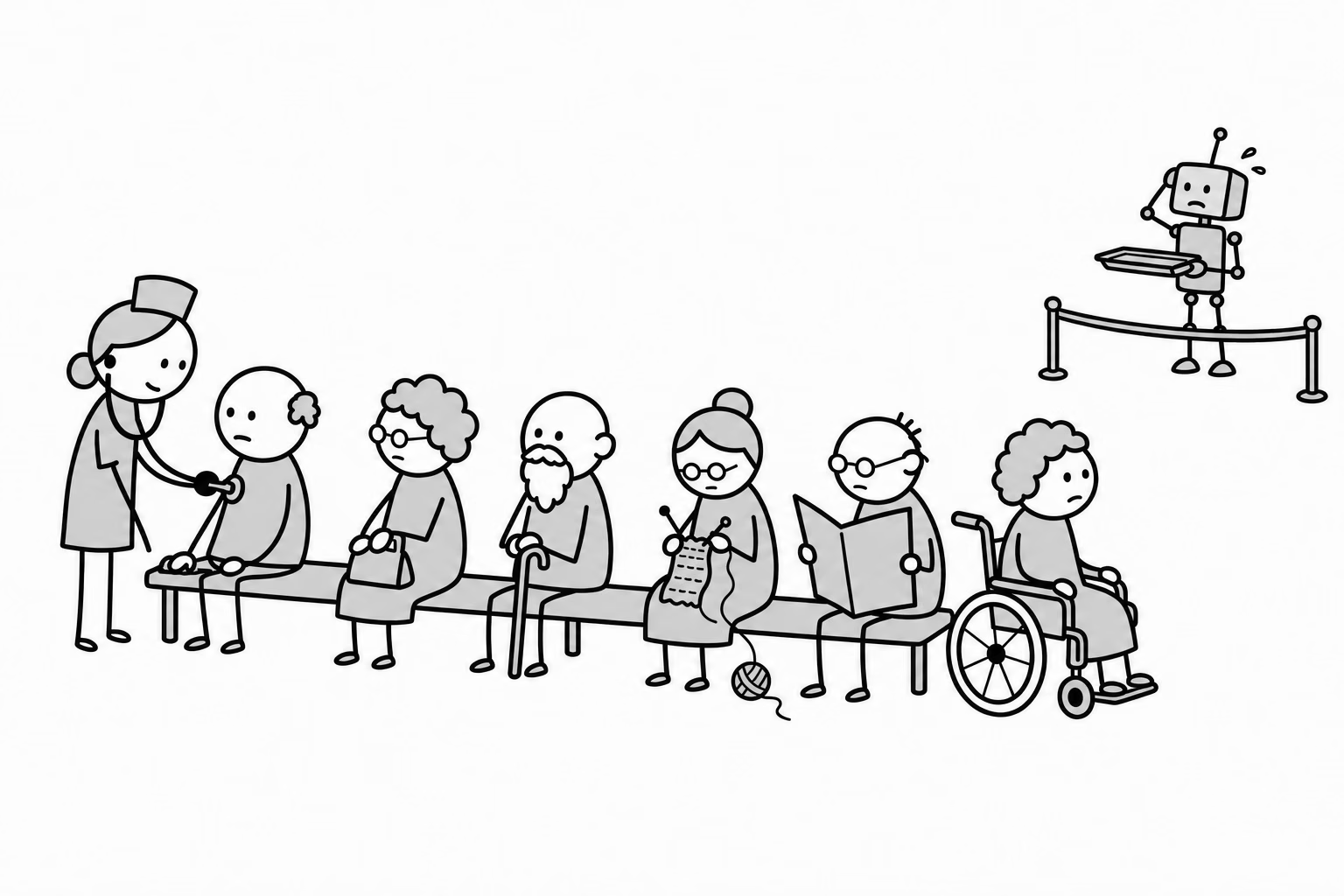
Look at the proportions in that drawing, because they are the forecast: a bench that lengthens at the fixed demographic rate, one carer as the entire supply side, and a robot standing behind a rail it does not actually need, since the room is the one environment its denominator cannot survive.
So the corpus's prediction, arrived at independently from yesterday's ownership argument, which is the best kind of evidence a forecast like this gets: the acute labor problem of the 2030s in advanced economies is a shortage in care and skilled trades, not a surplus in cognitive work. Real wages in both outpace the credentialed professions. Call the underlying squeeze the Care Collision, and note its bitter geometry: the one labor market that tightens hardest is the one the technology cannot enter, in the service of the generation that owns the appreciating assets, staffed by the cohort that does not.
The standard policy answer is immigration, and the corpus's forecast for it is bleak in a specific way: immigration is most politically constrained in exactly the countries with the sharpest shortages. Expect that fight to be conducted entirely as a cultural question while being, underneath, an arithmetic one, the same misdirection pattern as the price split, and file it with this blog's growing collection of AI politics wearing other names.
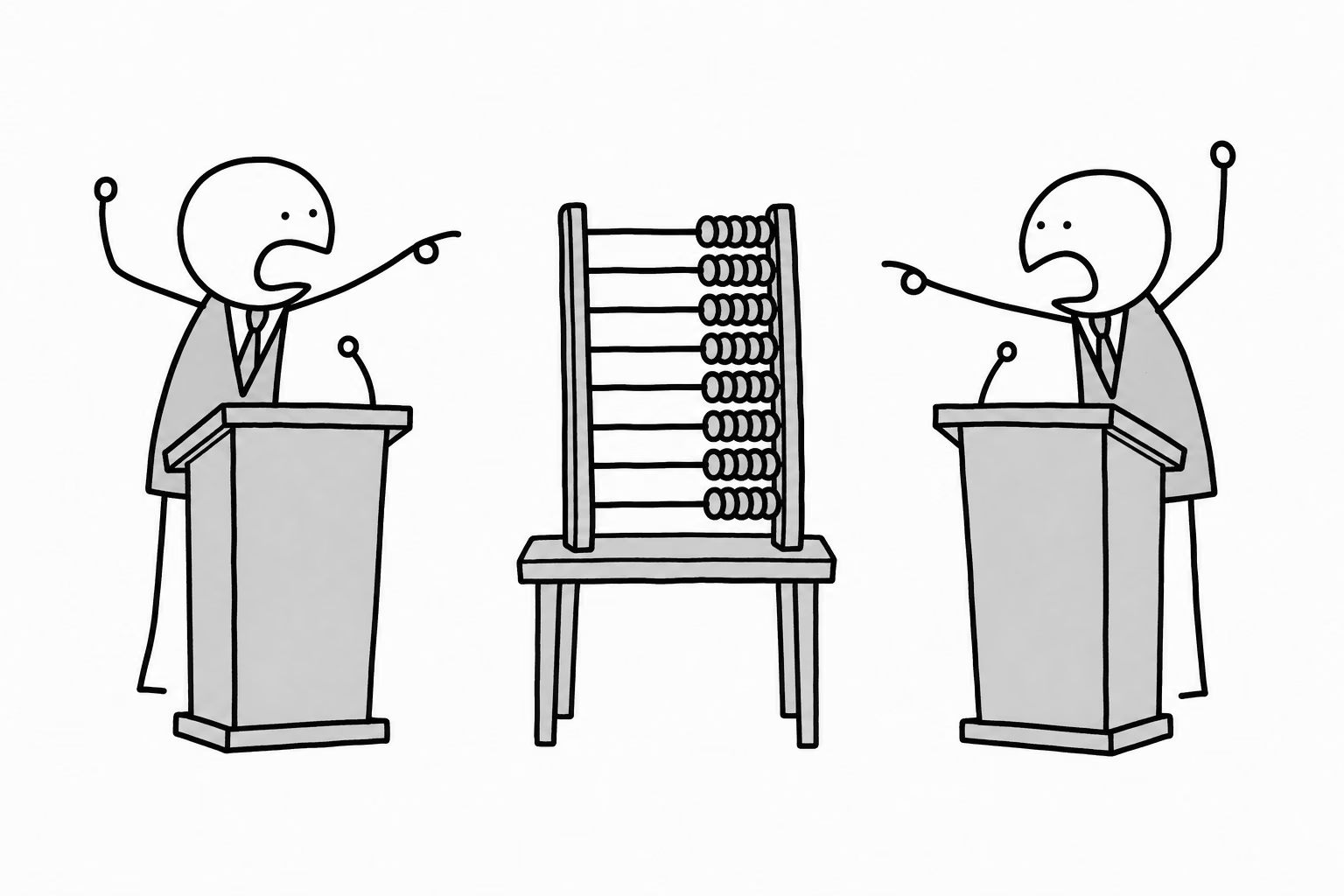
The beads on that abacus were pushed decades ago, by birth rates. The argument on either side of it is real and will decide real things. The arithmetic is not listening.
"The projections always say this, and the workforce always shows up"#
The strongest objection deserves its full strength: headcount is determined, but hours worked is a policy variable, and the corpus lists three dials honestly. Migration is the largest, and historical projection error on it dwarfs the error on fertility. Participation is second: retirement ages, female participation, and older-age health have each moved effective labor supply by percentage points within a decade, and an economy short of workers pulls all three levers at once.
The third dial is the one this blog is unusually placed to name, and it cuts against this very post: AI as a participation technology. If cognitive augmentation lets a 68-year-old stay productive in a role that previously forced exit, the technology partially manufactures the labor supply whose scarcity this page leans on. That is a genuine erosion channel, the corpus files it on the same watch list as every other complement with a half-life, and if it runs strongly, the Offset weakens from the supply side and the care shortage eases from the inside.
What the dials do not touch is the composition. No participation policy restores the junior rung, and no migration target changes which tasks AI eats first. The objection moves the aggregate, which was already the reassuring half. It leaves the two compositional wounds, the apprenticeship gap and the Care Collision, exactly where they were.
What would prove this post wrong#
- The care and trades shortage fails to bite. If by the early 2030s advanced-economy care wages are not outpacing credentialed cognitive wages, something in the collision failed: robotics reached unstructured care early, immigration politics flipped, or participation stretched further than the precedents. The trades half already sits on the scorecard at 70%.
- China's pull weakens. The scorecard row this post opens: China holding a majority of global industrial-robot installations through 2030. If its share falls below half and stays there, the scarcity-pulls-adoption mechanism is weaker than the demographic arithmetic implies, and the durable-motive argument goes with it.
- Aggregate displacement bites anyway. If advanced economies with shrinking workforces still produce sustained AI-attributed unemployment above their pre-AI trend, the Offset failed, and the corpus's upper-bound reading of the labor game was too generous.
- The participation technology runs hot. AI keeping older cohorts in work at scale would be a good failure: it eases the shortage this post forecasts while confirming the technology's reach. The composition claims survive even then.
Every economic anxiety of the twentieth century assumed more people were coming. Every plan for the twenty-first is quietly discovering they are not.
The robots are not taking the jobs. They are inheriting the vacancies, and the fight worth having is over the two rooms where the vacancies and the robots cannot find each other.
Where this comes from
Every number above is carried by a page in the corpus. These are the ones doing the work:
- Demography - the large, predictable force pointing the other way 09-macro/demography.md
- Game 4 - Labor 02-games/4-labor.md
- Uncertainty 3 - The shape of the apprenticeship gap after institutions respond 06-uncertainties/apprenticeship-gap.md
- Fiscal - a tax base built on labor income 09-macro/fiscal.md
- United States and China - asymmetric bottlenecks 03-domains/contested/geopolitics/bipolar.md
Or interrogate the whole thing directly: ask the corpus.