The Cheapest Decade in History Will Feel Expensive
AI pushes the cognitive half of the economy toward free while energy, housing, care, and the trades inflate. Households only experience the second half, the statistics mismeasure both, and that gap becomes the central politics of the 2030s.
Contents
In the 1960s the economist William Baumol noticed something strange about string quartets. A quartet in his day played Beethoven with exactly as many musicians, taking exactly as long, as a quartet in Beethoven's day. Productivity growth in live chamber music over a century and a half: zero. And yet the musicians' wages had risen enormously, because they had to be paid enough not to leave for jobs in the parts of the economy where productivity was growing.
The conclusion generalizes into one of the few genuinely load-bearing ideas in economics: sectors that cannot get more productive become relatively more expensive forever, dragged upward by wages set elsewhere. It is why a haircut, a hospital bed, and a college year kept outpacing inflation for your entire life while televisions did the reverse. Nobody voted for that. It fell out of arithmetic.
Now run the arithmetic through a productivity shock with an unprecedented shape: one that lands almost entirely on work done with words, numbers, and pictures, and barely at all on work done with hands, buildings, and bodies in rooms.
Everything Baumol said still holds. It just runs inverted and compressed. The classic version took a century and people barely noticed it happening. This version does the same divergence in about a decade, and the forecast in this post is that it becomes the defining political fact of the 2030s, misdiagnosed the entire time as something else.
One line splits the whole economy#
The unusual thing is not that relative prices move. They always move. The unusual thing is that this time the split falls along a single clean axis, and the axis cuts through every consumption category at once: is the cost of this thing mostly cognition, or mostly something intelligence cannot manufacture?
| Getting cheap | Getting expensive |
|---|---|
| Software, analysis, design, drafting | Electricity and everything energy-intensive |
| Media and content of every kind | Land, housing, anything with a location |
| Routine professional services | Skilled trades: plumbing, electrical, HVAC |
| Translation, tutoring, research help | In-person care, healthcare delivery |
| Diagnostics, documentation, first-pass law | Anything needing a licensed body in a room |
The left column is where capability flows and where the floor falls. The right column is the short list of complements the whole corpus keeps circling: energy, land, presence, licenses. Cognition heads toward free. The complements do not. The ratio between the columns moves by orders of magnitude in a decade, and the rest of this post is about the two ways that ratio gets systematically misread, by statistics and then by politics.
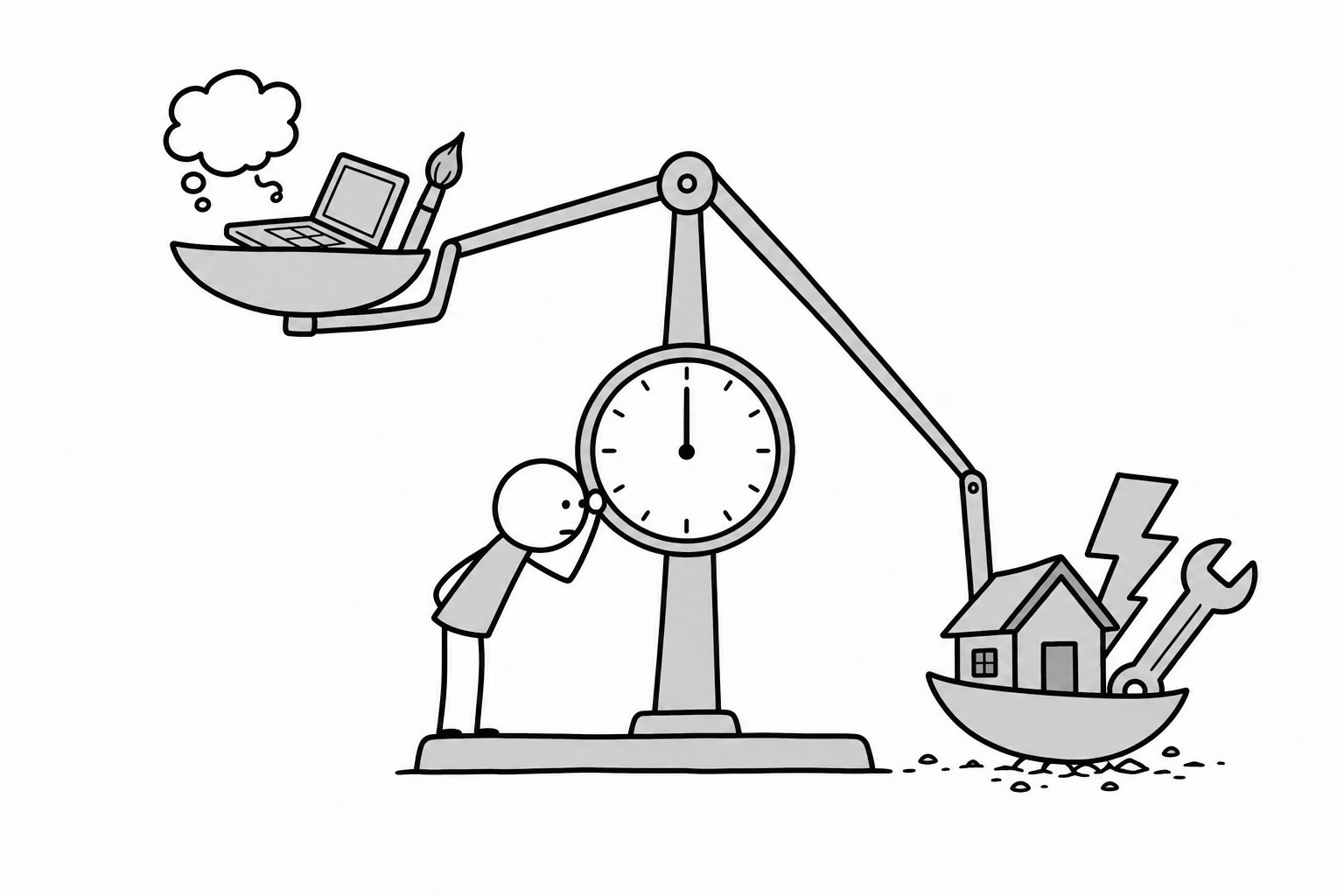
Look at what the balance in that drawing is doing: one pan rising, one pan crashing, needle pointing serenely at the middle. Keep the needle in mind. It comes back wearing a central bank's logo.
You will not notice the half that is working#
Start with the statistical misread, because it feeds the political one.
When a service gets ten times better at the same price, or becomes free at a slightly lower quality most users prefer, official price indices capture almost none of it. That is the hedonic measurement problem, it is decades old, and AI makes it acute, because Game 3's whole prediction is that the surplus lands on consumers in exactly the forms indices miss: free tiers, bundled features, quality jumps, and hours of your life handed back untransacted.
Call this the Ambient Discount. It is real, it is likely enormous, and it is delivered in a form that produces no receipt. Nobody's monthly budget has a line reading "legal question answered at midnight for nothing," or "tutor for the eight-year-old, previously unaffordable, now ambient." The discount arrives as an absence.
Human beings do not itemize absences.
Now put the two halves side by side. The gains arrive ambient and unpriced. The costs arrive as the most legible objects in a household's month: the electricity bill, the rent, the plumber's invoice, the insurance premium. The corpus compresses the asymmetry into one sentence: nobody notices that analysis got free, and everyone notices the electricity bill.
Three mechanical consequences follow. Measured inflation overstates the true cost of living, because it captures the inflating physical half and misses the deflating cognitive half. Measured growth understates true welfare, for the same reason. And policy gets set on the mismeasured series, because central banks can only respond to the index they have. The transition may be considerably better for human welfare than the statistics will ever show, and considerably worse for the politics, and both errors have the same cause.
The seesaw only comes with one thermostat#
Here is the needle from the drawing again. A central bank owns one policy rate, and its target is an index averaging two opposite movements. If cognitive deflation and physical inflation roughly cancel, headline inflation reads fine, and the single policy stance is simultaneously too tight for the deflating half and too loose for the inflating half. The average is not information. It is camouflage.
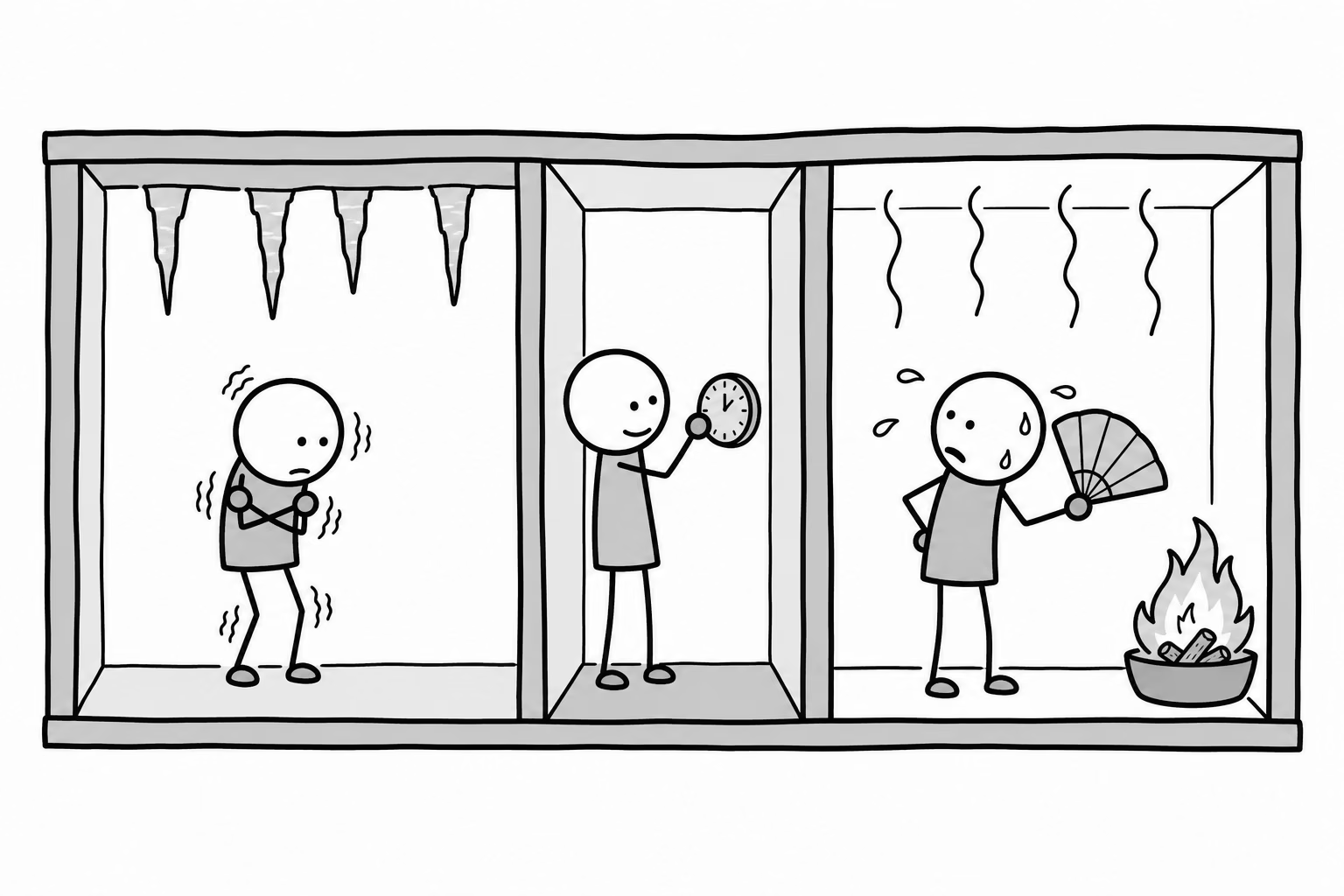
The figure at the dial is doing everything right. One room is freezing, one is on fire, and the hallway reads seventy-two. That is monetary policy in a split economy, and it is worse than useless against the hot room specifically: raising rates does not build transmission lines, train electricians, or zone housing. It mostly suppresses the investment that would eventually relieve those constraints, which the 2020s already demonstrated at smaller scale.
So the forecast, from the corpus at its published confidence: by the early 2030s, a live and serious debate about whether headline CPI is fit for purpose as a policy target, with proposals to target a services-and-shelter subindex or to strip technology-driven deflation. And roughly 50% that a major central bank formally revises its target definition or tolerance band by 2035. That number goes on the scorecard.
The politics will be about prices and say it is about AI#
The distributional shape is what turns arithmetic into politics. Low-income households spend disproportionately on the right-hand column, energy, housing, food, care, transport. High-income households consume proportionally more of the left. So the split is regressive on its face even while the aggregate welfare effect is positive and possibly large. The gains are real and widely spread, in the form easiest to under-notice. The losses are concentrated in the most salient bills a household has.
That asymmetry is more politically consequential than the employment story this blog spent two posts on, and the reason is coverage: job displacement concentrates in specific cohorts and occupations, while the price split touches every household every month. And it is already possible to say what the politics will look like, because the early versions are running. Energy-price interventions, subsidies, caps, and the large-load tariff fights that the bottleneck post put a scorecard row on. Housing politics intensifying, land being the purest inelastic complement there is. Pressure campaigns on healthcare and education costs, the two categories that shrugged off every previous technology-driven deflation.
Each of these will be described as society reacting to artificial intelligence. Watch closely and you will see something more specific: society reacting to the right-hand column, while the left-hand column quietly pays for it and gets no credit. There is even a place where the two errors are written into law simultaneously: indexation. Pensions, benefits, and tax brackets ride headline CPI. For households consuming the deflating basket, headline overstates their cost of living and indexed transfers overcompensate, feeding the fiscal squeeze. For low-income households in the inflating basket, the same index understates their experienced inflation and undercompensates exactly the people the split hits hardest. One index, two populations, opposite errors, and the fight over fixing it will be conducted as a measurement dispute while being a distributional one.
"Prices always diverge. Why is this time different?"#
Fair, and the honest answer has two parts.
The first is speed and correlation. The classic Baumol drift moved a few percent a year and scattered across categories. This version is a step change compressed into a decade, falling along one axis that everyone can eventually name, and the corpus's scoring rule is built to catch exactly that: sustained divergence between the cognitive and physical CPI baskets, held for eight consecutive quarters before it counts. One energy spike or a software discount season is noise. Eight quarters is a regime.
The second is that the claim is genuinely conditional, and the conditions are institutional rather than technical. The right-hand column inflates given current supply institutions. If permitting reform actually clears the energy build and housing liberalization spreads, the physical basket moderates and the split narrows into something an index can average honestly. That is the benign failure, and it is precisely what several of this blog's earlier posts argue the political system is currently refusing to choose. The malign failure is quieter: if the complements inside services reassert themselves, the licensed body in the room, the liability holder, the balance sheet that must sign, then measured services prices never fall much, the left column's deflation stalls at the checkout even as costs collapse, and the two economies fold back into one with the surplus captured as margin instead of passed through as price.
What would prove this post wrong#
- The split fails to show. If the cognitive-versus-physical CPI divergence has not run eight consecutive quarters by the end of 2030, the axis was wrong or the institutions moved faster than forecast, and the political predictions downstream collapse with it. Scorecard row, opened at 70%.
- No central bank blinks. If by 2035 no major central bank has revised its target definition or tolerance band, and the CPI-fitness debate stays confined to working papers, the one-instrument problem was more absorbable than argued. The corpus's 50% resolves no.
- The benign narrowing. Permitting and housing reform moderate the right-hand column. This post would be delighted to be wrong this way, and says so in advance.
- Pass-through failing. If services prices hold while underlying cognitive costs collapse, watch margins, then the deflation existed and was captured rather than distributed. Different post, different villain, same falsified forecast here.
Somewhere around 2032 a politician will win a difficult election on the cost of living, in the middle of what may be the fastest real enrichment ever mismeasured, and both facts will be true at once.
The discount is ambient. The bill has your name on it. Elections are held among the named.
Where this comes from
Every number above is carried by a page in the corpus. These are the ones doing the work:
- Prices and the Two Economies 09-macro/prices.md
- Game 3 - Firms 02-games/3-firms.md
- Energy - the constraint that bites before capital does 01-substrate/energy.md
- Diffusion - The Economic Ledger (B2, B3, B5, B7) 07-indicators/diffusion/economy.md
- Fiscal - a tax base built on labor income 09-macro/fiscal.md
Or interrogate the whole thing directly: ask the corpus.