The AI Race Ends in a Refinancing
If the 2027 to 2029 correction arrives, it starts as a credit event in the machinery financing AI datacenters, not as a bad quarter at a big lab. Here is the sequence, the casualty list, and what survives it.
Contents
- Three kinds of money, sorted by what makes them stop
- The revenue has an echo in it
- The collateral is standing on the falling floor
- The sequence, in order, with things to watch
- "If the returns are not there, why is everyone still spending?"
- What survives, which is the actual point
- What would prove this post wrong
Every input to the AI build-out has a ceiling that people worry about, except the one paying for the other three.
Chips have a ceiling, guarded by one strait and a handful of fabs. Power has a ceiling, made of interconnection queues and turbine order books. Data hit its ceiling years ago, which is how the whole verification story started. And then there is capital: roughly 700 to 725 billion dollars of it across the four largest hyperscalers in 2026 alone (company guidance through mid-2026), and capital has no ceiling at all. There is no physical limit on how much money can flow into datacenters. Nobody has ever waited in an interconnection queue for money.
That sounds like the one comfortable fact in the story. It is the opposite, and the corpus compresses why into one sentence: compute, energy, and data are constraints. Capital is a verdict.
A constraint binds you the honest way, slowly and physically, and you can watch it coming for years. A verdict is a continuously re-priced judgment about whether the money comes back. It is the only one of the four inputs that can reverse, and it can reverse in a quarter. Call it the Verdict, because that is what this post is about: when it flips, what flips it, and who is left standing afterward.
So here is the forecast, stated up front so it can lose. If the correction the corpus dates to 2027 through 2029 arrives at all, its proximate trigger is a credit event in AI-adjacent structured finance, not an earnings miss at a hyperscaler. The corpus holds that at 65%, and this post walks the mechanism in enough detail that you can score it quarter by quarter on the way down. And when it fires, it culls by financing type rather than by research quality, which is the part almost nobody prices.
Three kinds of money, sorted by what makes them stop#
All dollars build the same datacenter. They do not stop for the same reasons, and in a correction the stopping rule is the only thing about a dollar that matters.
| The money | Its discipline | It stops when |
|---|---|---|
| Hyperscaler operating cash | High. Competes with buybacks, visible quarterly | The board loses patience. One earnings cycle. |
| Private credit, SPVs, vendor financing | Low. Off balance sheet, lightly disclosed | A credit event. Violently, with contagion. |
| Sovereign and quasi-sovereign | Very low. The return is strategic | Political turnover. Five-year cycles, or never. |
The first row is self-limiting and legible: if the spend stops earning, a board meeting ends it, and the world gets a spending pause. The second row is neither: debt secured against depreciating accelerators does not pause, it defaults. The third row is not buying a return at all. A state buying compute is buying the option not to depend on someone else's compute, and strategic goods are bought at prices that make no commercial sense, indefinitely.
Which is why the single most important thing to watch in AI finance is a migration: through 2025 and 2026, the money moved from the first row toward the second. The build is increasingly funded by structures whose failure mode is not a pause but an event.
The revenue has an echo in it#
Before the sequence, one complication, because the Verdict is only as good as the evidence it prices, and the evidence has developed a loop.
Chip vendors invest in model labs that commit the proceeds to chip purchases. Hyperscalers book cloud revenue from labs they hold equity stakes in. Neocloud operators borrow against accelerator collateral whose resale value depends on the same AI demand the borrowing exists to serve. None of this is fraud, and all of it is precedented: vendor financing looked exactly like this in the late-1990s telecom build. But it means headline AI revenue contains a reflection of the capex itself. Call that reflection the Echo. The true external-demand signal, the money arriving from customers who are not also suppliers, lenders, or shareholders of the ecosystem, is smaller and noisier than the reported one, and almost no public figure is stated net of it.
Honesty requires the other half: the Echo is also what early genuine demand looks like. A real ecosystem bootstrapping real capacity finances itself in exactly these patterns, and telecom's vendor-financed build left behind the fiber the internet actually runs on. The test is not the structure. The test is the exit: whether end-customer revenue grows into the financing, or the financing rolls onto new lenders. Watch which one is happening, because only one of them ends well for the second row of the table.
The collateral is standing on the falling floor#
Now connect this to the post about inference costs, because the same fact appears twice in this story wearing different clothes.
From the product side, cost at fixed capability falling a hundredfold or more every two years is the falling floor: any given level of intelligence becomes nearly free on a published schedule. From the lender's chair, that identical fact reads differently. A loan secured against racks of accelerators is a loan whose collateral produces a commodity with a published crash schedule. The chips depreciate in three to six years physically, and the thing they make loses its price faster than that. Lending against them is lending against ice.

That is the drawing to keep in mind for the whole post: the ice block with the circuit lines is the accelerator fleet, and the puddle spreading on the desk is the part of its value that the next model release and the next price cut already removed. Nothing dramatic has happened in the picture. The drip is the whole event.
There is one exception inside the collateral, and it decides the aftermath. A rising share of the spend, on the order of 240 billion dollars of 2026's total, is not silicon at all but land, shells, substations, and interconnection rights, assets that last thirty years and sit on the short list of things intelligence cannot manufacture. A drawdown strands the chips and leaves behind powered land. Hold that thought for the last section.
The sequence, in order, with things to watch#
Here is the pathway the mechanism implies. Not dates, an ordering: each step is observable before the next one starts.
Step one, already running: the mix shifts. Capex growth outruns operating cash, and the gap fills with private credit, SPVs, and vendor paper. The indicator to score is financing mix and collateral structure, and the corpus is explicit that analyst skepticism on earnings calls does not count. Scrutiny can rise for years while the mix keeps drifting. Watch the mix, not the tone.
Step two: the haircuts widen. Accelerator resale prices soften as newer silicon and the falling floor reprice old fleets, and lenders quietly raise the discount they apply to chip collateral at each renewal. This is the step that happens in term sheets rather than headlines, which is why almost everyone will miss it.
Step three: a refinancing fails. Some neocloud or SPV arrives at its roll date and finds lenders willing to renew only at terms its contracted revenue cannot cover. Somewhere in the workout, a revenue contract that counted as AI demand turns out to have been the Echo: a commitment from an entity financed by the same ecosystem it was buying from.
Step four: the marks propagate. The failed structure forces a repricing of every similar structure, because now there is a traded price for distressed accelerator collateral. This is what "reverses violently and with contagion" means in the table above.
Private credit does not do gradual.
Step five: the cull sorts by financing, not by quality. This is the forecast's least intuitive claim. A correction is differentially destructive: it removes exactly the labs financed commercially and leaves standing the ones financed strategically, sovereign, hyperscaler-backed, state-directed, regardless of who was doing the better research. Game 1 adds the reason the commercial pure-plays are the exposed class in the first place: a pure-play lab's value outside the race is roughly zero, and contest theory says the player with the worst outside option rationally spends the largest share of its resources on the contest. Their balance sheets are all bet. The corpus's standing prediction, carried at its published confidence: a majority of pure-play frontier labs merge, pivot to applications, or become state-adjacent within 24 months of the trough, and the frontier consolidates to three to five labs globally by 2029.
"If the returns are not there, why is everyone still spending?"#
Because everyone spending is individually correct, which is this blog's second commons story in a week.
The lab race is not a prisoner's dilemma, where cooperation is stable if only everyone would agree. It is a contest: the prize goes to the leader, effort buys probability of leading, and the marginal return on spend is highest exactly when the contestants are closest. Contest theory predicts aggregate spending in that situation exceeds the value of the prize, over-dissipation, and predicts budgets ratcheting after every rival's release, which is precisely the observed pattern since 2023.
Now add the twist that makes the present moment strange: the prize is shrinking while the spending accelerates. The open-weight tier now trails the frontier by three to six months (Epoch AI, January to May 2026 series), down from nine to fifteen in earlier analyses, so a frontier lead is a thinner wasting asset every year. Rational contestants respond by spending more to buy a temporary lead even as the lead is worth less. That is an equilibrium story about a race structure rather than a bubble story about fools, and it is why the spending will not stop voluntarily. It stops when the Verdict stops it.

The three figures passing the coin are the chip vendor, the lab, and the cloud, and the coin has been counted as revenue on each pass. The Verdict, when it arrives, is the moment someone outside the circle asks to see the coin.
What survives, which is the actual point#
A credit event in 2027 or 2028 will be reported as the end of the AI era, the way 2001 was reported as the end of the internet. Both descriptions are wrong the same way, and the corpus is specific about what resets and what does not.
What resets: secondary-lab financing, frozen for years. Hyperscaler board patience, shortened for a cycle, which cuts training-run ambition more than inference capacity already built. Vendor and SPV markets, repriced with fat haircuts.
What does not reset: the research lines at state-adjacent and cash-rich labs. The open weights already in the wild, which no margin call can recall. And the powered land, which appreciates, because a cull of competing demand makes surviving interconnection rights more valuable, not less. The correction strands the ice and keeps the ground it was sitting on.
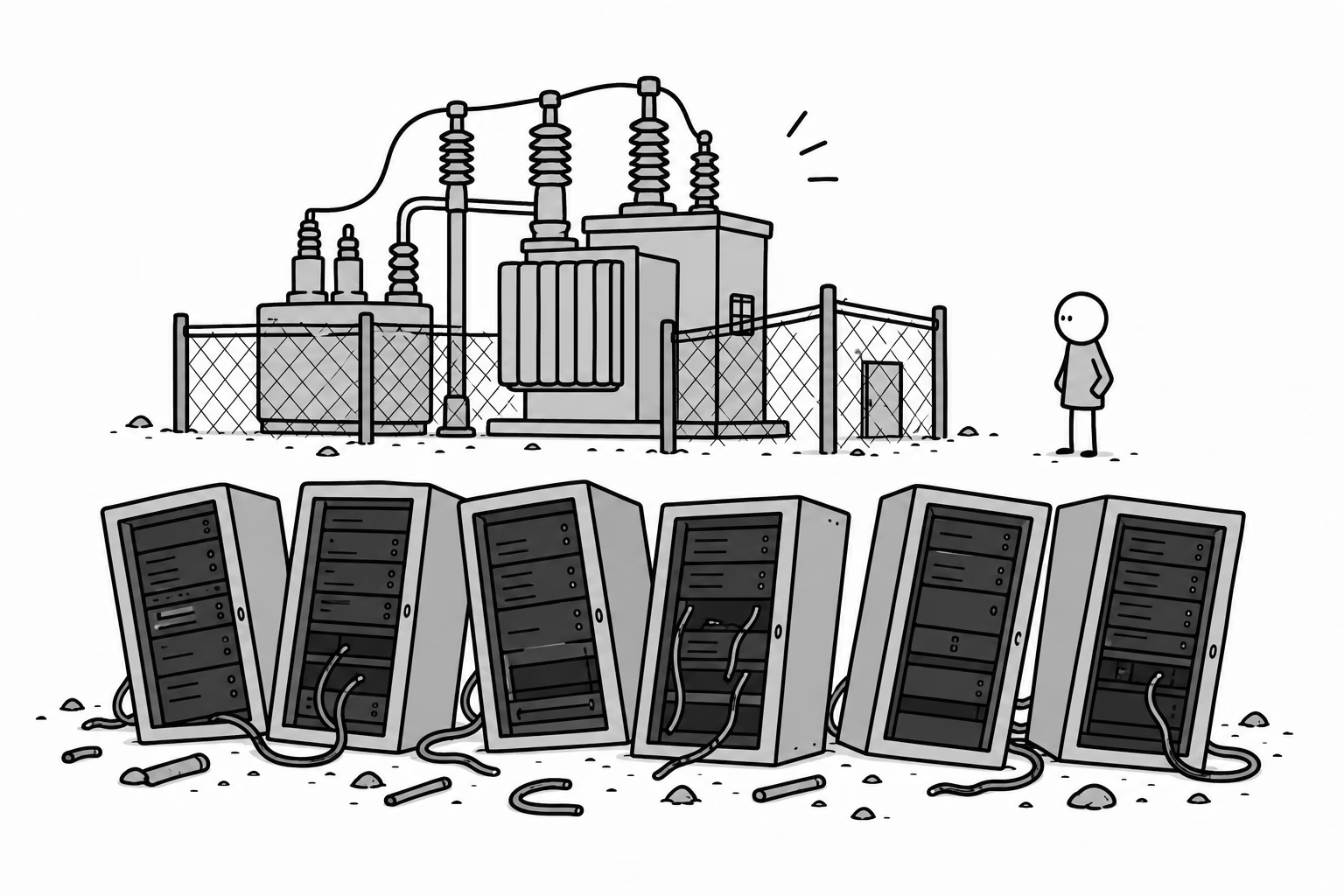
The dark racks in that drawing were three-year assets. The substation was a thirty-year asset, and it just lost its queue competitors. This is a capital winter, not a capability winter, and the difference between those two sentences is the difference between 2001 and what people feared 2001 was.
The consolidated field that emerges, three to five labs, most of them strategically financed, does not end the race. It changes the currency, from market position toward strategic position, and hands the safety-relevant competition from firms to governments. The endgame of the lab race was never a winner. It is a handoff.
What would prove this post wrong#
- No credit event by the end of 2029, with the build continuing. Then the Verdict held, the second row of the table was sturdier than it looked, and this post overweighted the telecom precedent. The scorecard row resolves against the 65%.
- Revenue per dollar of capex improving. If inference revenue scales super-linearly against infrastructure spend, plausible if agents get sold on outcomes rather than seats, external demand grows into the financing and the whole question dissolves without a correction.
- The depreciation schedules proving conservative. If old accelerators keep earning past six years because inference demand absorbs them, the ice melts slower than the loans amortize, and lending against chips was fine all along.
- The mix migrating back. If 2027 disclosures show financing returning to operating cash, the credit-event path loses its fuel even if demand disappoints. The downside becomes a spending pause, the first row's failure mode, and the differential-destruction claim never gets tested.
- The cull sorting by quality instead of financing. If commercially financed labs with strong research survive while state-adjacent ones fold, the contest model missed something important about what the contestants were actually playing for.
The race will not end with an announcement of victory. It will end in a conference room, at a roll date, between a borrower who needs one more renewal and a lender holding a puddle where the collateral used to be.
Everyone is watching the models. The Verdict is watching the term sheets.
Where this comes from
Every number above is carried by a page in the corpus. These are the ones doing the work:
- Capital - the input that is not scarce, and why that is the problem 01-substrate/capital.md
- Game 1 - Labs 02-games/1-labs.md
- Inference Economics - the two-year moat 01-substrate/inference-economics.md
- A - Substrate Indicators 07-indicators/substrate.md
Or interrogate the whole thing directly: ask the corpus.