The Taiwan Risk Is Not the One You Are Watching
The likelier failure is not an invasion but a quarantine, a war-risk insurance premium, and an export licence that takes eleven months instead of three.
Contents
Somewhere in London there is an underwriter who has never read an AI research paper and does not intend to start.
Their job is to price marine cargo through a particular stretch of water. They do this by reading things that are extremely boring: naval movement notices, port congestion reports, the reinsurance market's mood. And on some ordinary Tuesday, that person raises the war-risk premium on a route, or starts declining a class of cargo they used to accept.
No headline. No emergency session. A number in a spreadsheet moves.
That underwriter will know that something has changed months before anyone in this industry does, and years before it becomes a story with a name. And their spreadsheet, not the naval movements, is the thing that will first make your GPUs arrive late.
Because the single most important assumption in AI forecasting does not break the way it gets argued about. It breaks in a spreadsheet, and the distance between those two things is what makes it dangerous.
The assumption everything rests on#
Every projection about AI, including all the ones in the corpus this blog sits on, assumes that Taiwanese fabrication continues.
That assumption is doing more work than any other single input, and it is not an AI question.
The corpus states it so it can be scored:
~90% no major disruption to Taiwanese leading-edge output through 2032.
Now, an important thing about that number, because people misread what kind of number it is. It is not a confident geopolitical judgment. Nobody involved is claiming special insight into the intentions of the Chinese Communist Party. It is a modelling assumption, written down explicitly so that readers know what they are accepting when they accept everything downstream of it.
And everything is downstream of it. Training-run cost curves. The chokepoint analysis. Robotics electronics supply. The capex test. Every single timeline date.
There is a specific reason this deserves your attention rather than a footnote. Most of the big uncertainties in AI forecasting are skewed toward better outcomes. Research automation might go faster than expected. Permitting might get reformed. Institutions might respond to the apprenticeship gap. When those break, they mostly break pleasantly.
This one does not. This is the single scenario that invalidates the entire document, and it is the one uncertainty with no good tail.
Which is exactly why the framing is wrong#
Here is where the framing goes wrong, including in the corpus until fairly recently.
The debate is conducted as a coin flip. Either Taiwan is fine, or there is an invasion and the world ends. Two boxes. Pick one, argue about the odds, go home.
But "no major disruption" and "capacity removed for years" are not a distribution. They are two points at opposite ends of one, and there is an enormous amount of space between them that nobody is looking at.

Everything crammed into that middle is individually more likely than an invasion, and collectively far more likely than either endpoint. Call it the Gray Zone:
- A quarantine or inspection regime that throttles shipments rather than stopping them
- Cyber or sabotage events that cut fab output for months rather than years
- An escalation spiral where the fabs keep running perfectly, but insurers, shippers, and export regulators start treating the strait as a war-risk zone
Notice what all three have in common. None of them zeroes the arithmetic.
They reprice it.
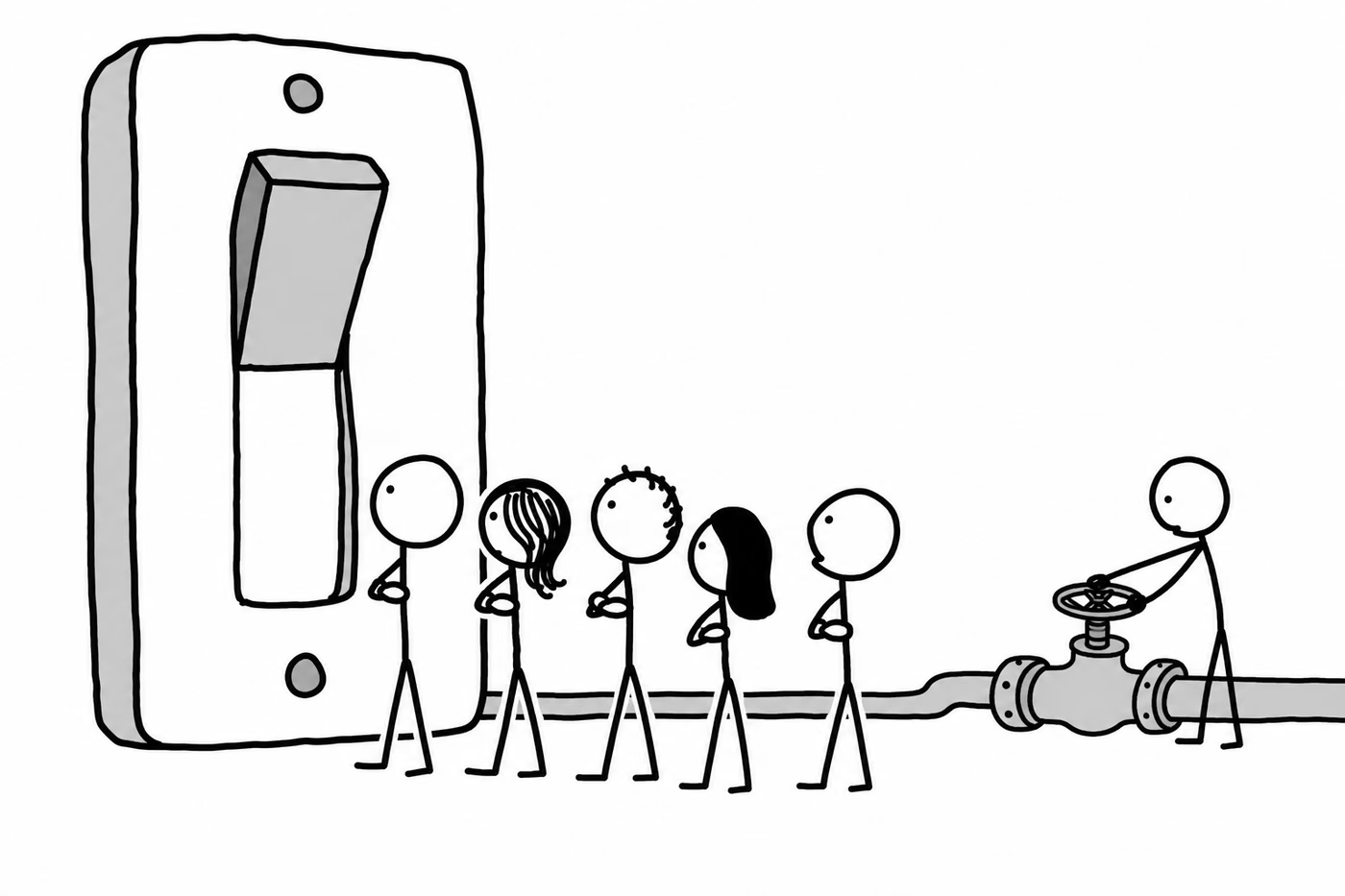
Accelerator supply does not vanish. It becomes rationed and politically allocated. The capex test does not fail, it inflates. Timelines do not slip years, they slip quarters, but with a persistent risk premium that never fully unwinds.
Everyone is standing around the big red switch, watching to see if anyone touches it. The valve is over there, and it is already being turned.
The part that should worry you#
Now for the finding that made me want to write this, because it is subtle and it is bad.
The assumption is stated as "~90% no major disruption."
The assumption is used as "supply keeps flowing to the buyers we are modelling."
Those are different sentences. The second one is much stronger than the first, and it is the one every downstream conclusion actually rests on.
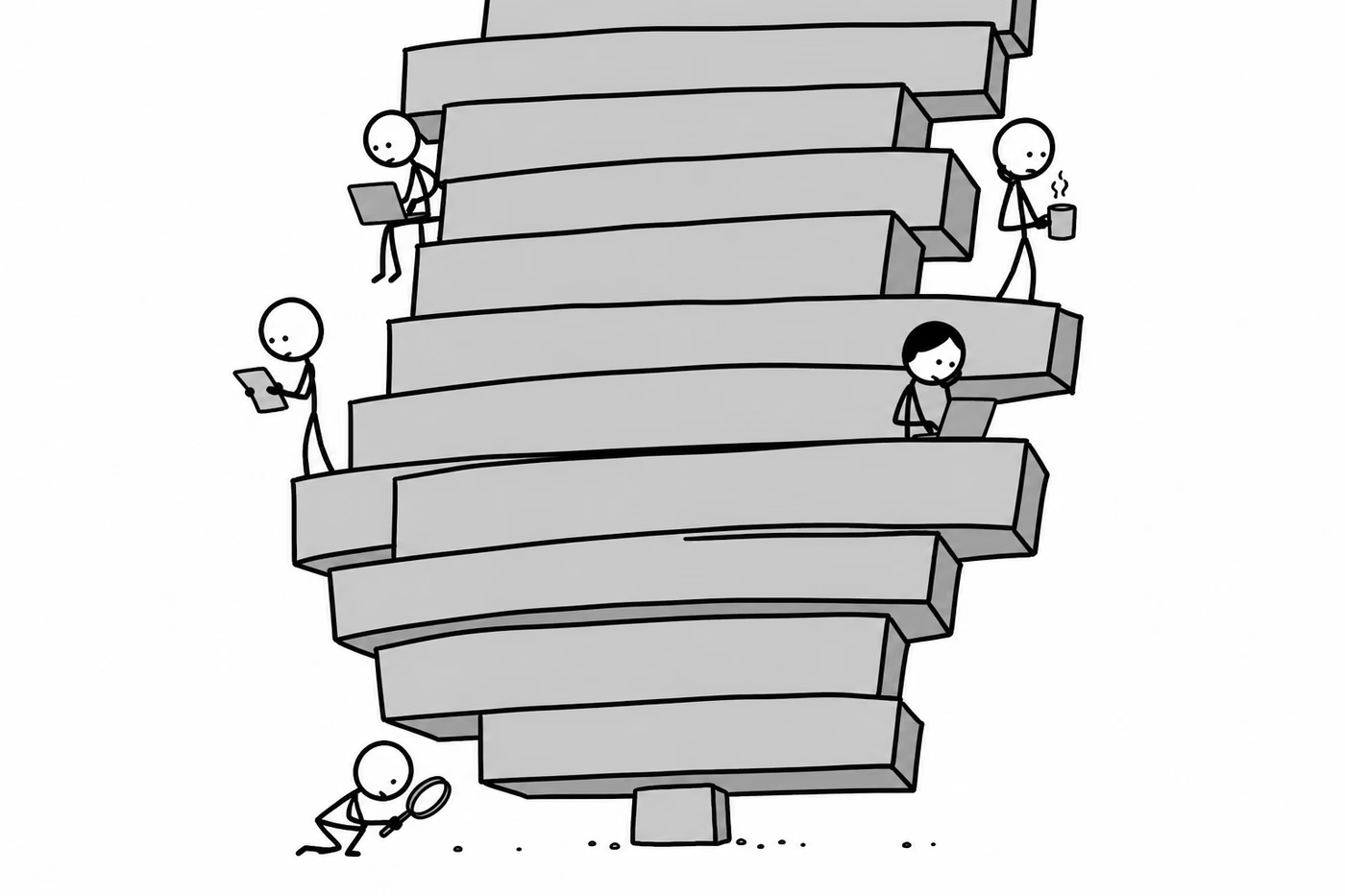
Which means the assumption can fail without any crisis whatsoever. An export-control stair-step that fully bifurcates the ecosystem does it. Taiwan itself weaponising supply in a negotiation does it. In both cases, leading-edge output continues at full volume, every crisis indicator stays green, the 90% line item holds beautifully on its own terms, and the forecast is already wrong for anyone actually trying to buy a chip.
That gap between the scored assumption and the consumed one is not a nuance. It is an audit finding.
The Green Dashboard#
Which brings us to the failure mode of watching this at all.
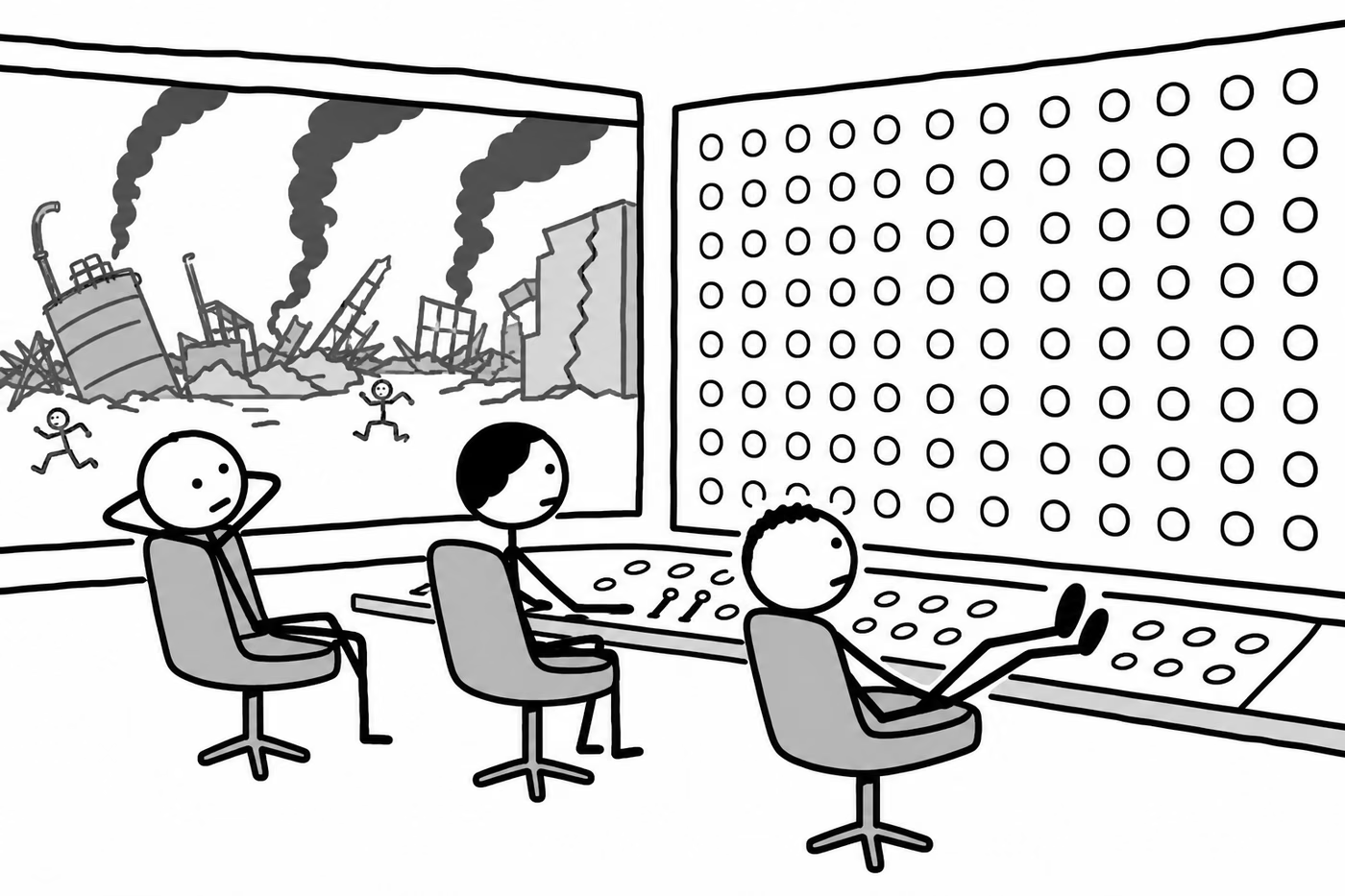
You can build a perfectly reasonable Taiwan dashboard. Amphibious activity. PLA posture. US force movements. Invasion language in official statements. All of it sensible, all of it worth tracking.
And you can watch that dashboard glow green all the way through the actual failure, because the actual failure does not appear on it.
The modal bad outcome is ambiguity, and ambiguity does not trip a crisis indicator.
So if you want to see this coming, you have to watch the boring instruments instead. In rough order of how early they move:
| Signal | What it means if it moves |
|---|---|
| War-risk and strait freight insurance premia, and denial rates | Shippers are pricing ambiguity. Capacity is still "available", just expensive |
| Export-licence denial and delay rates on advanced-node tools and wafers | Bifurcation without a crisis headline |
| Delivery-schedule slippage on accelerator and foundry orders, guidance versus last quarter | Soft rationing |
| Spot and contract price step-ups for leading-edge wafers with no demand-spike story | A political allocation premium |
| Corporate dual-sourcing spend announced as risk rather than as capacity expansion | Somebody's revealed belief that the 90% is eroding |
That last row is my favourite, because it is a confession. When a company frames a second supplier as capacity, that is growth. When it frames the same spend as risk mitigation, it has told you what it actually thinks and put a number on it.
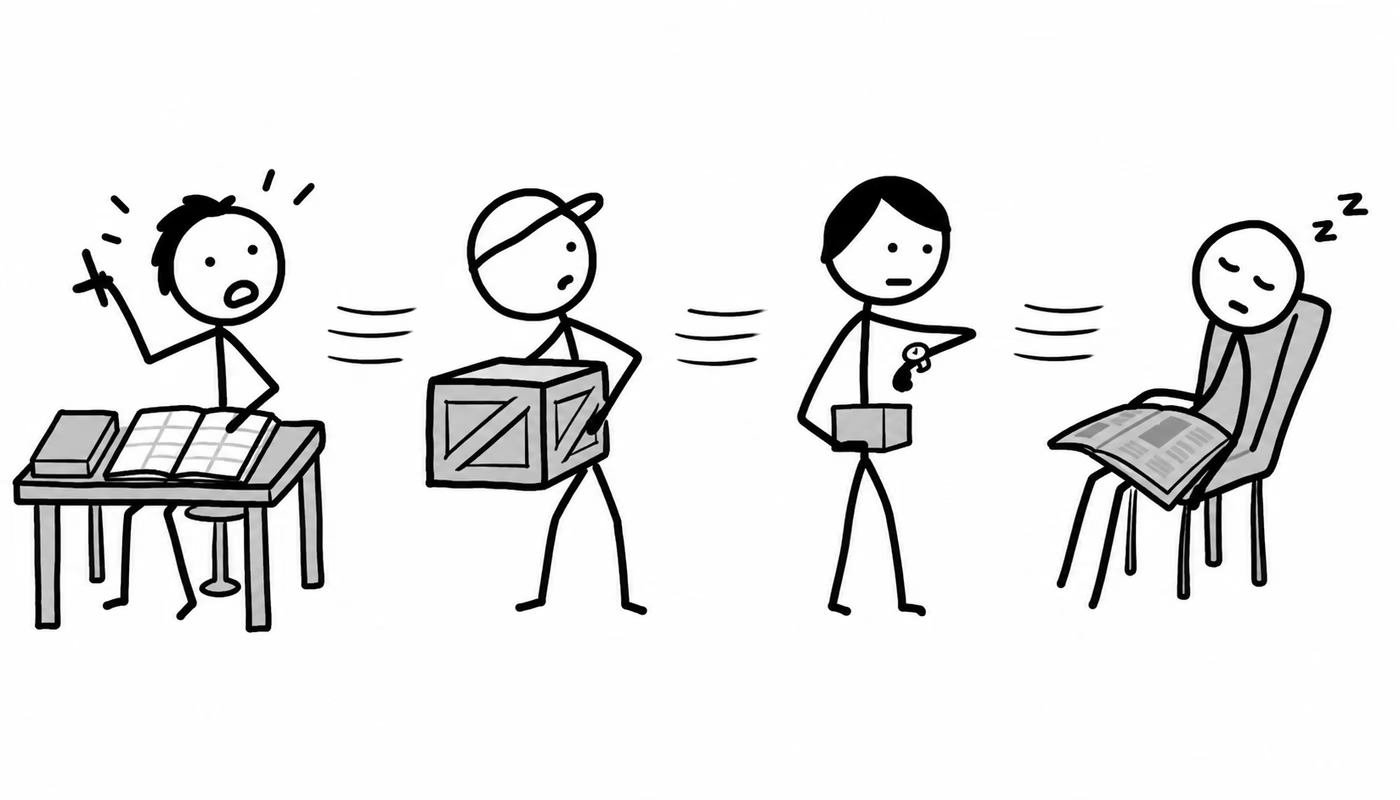
The order matters. By the time an event has a name, the insurance market has been repricing it for two quarters.
"But nobody would actually do it"#
This is the strongest objection and it deserves better than a brush-off, because it has been right every single time so far.
The argument is the silicon shield. All parties lose too much for deliberate disruption to be rational. Blockades are not accidents, the loss function is visible to everyone involved, and deterrence has held through every crisis to date. That is not wishful thinking. That is a real mechanism with a real track record.
Here is the problem.
The shield decays on our own timeline.
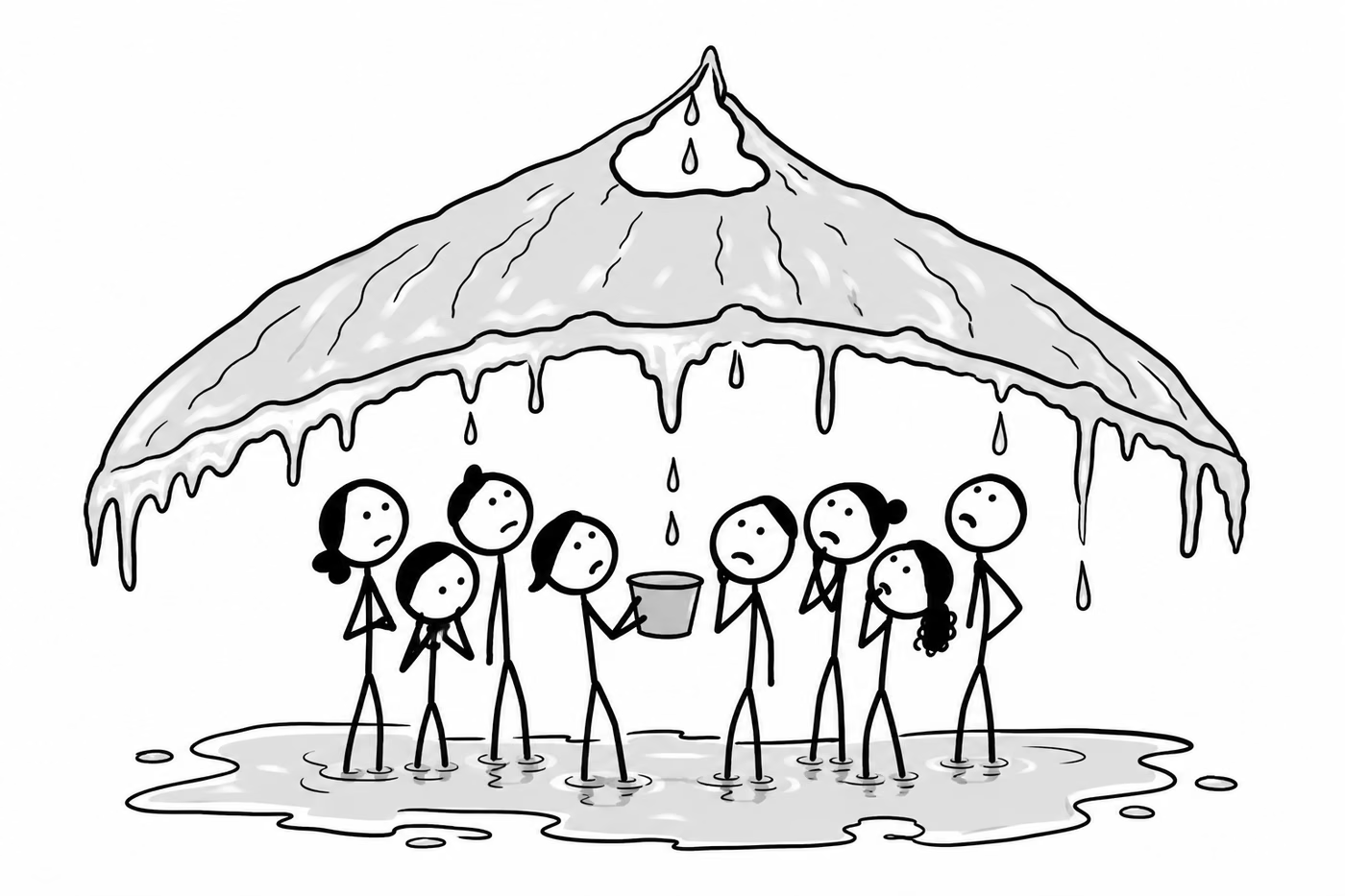
Every wafer of leading-edge capacity qualified outside Taiwan lowers the cost of disruption to the buyer side. Meanwhile the AI race raises the perceived cost of not acting for whichever side is losing it.
Which produces the nasty structural feature of this whole problem: the same progress that reduces the consequence of disruption also erodes the thing preventing it.

Diversifying fabs shrinks the damage and raises the incentive. Two arrows, same lever, pointing opposite ways, partially cancelling. Score one without the other and you flatter the trend.
This is why "non-Taiwan capacity is rising, so this risk is falling" is only half a sentence. Rising non-Taiwan share shrinks the consequence. It does not green-light the probability, and it may raise it.
What would change my mind#
- Non-Taiwan leading-edge share crosses a material threshold, with yields, before any crisis. Not announced fabs. Not ribbon-cuttings. Qualified wafers at node. That lowers the variance of this whole uncertainty without moving the point estimate on disruption at all, because it shrinks consequence rather than probability.
- Gray-zone indicators stay flat for several years while capacity diversifies. That would suggest the repricing channel I am describing is not actually live and the binary framing was adequate after all.
- A crisis that resolves cleanly in months rather than years, demonstrating that the substitution lag is shorter than the corpus assumes. The corpus is explicit that 2026 to 2028 and 2028 to 2032 have no substitute at volume. If that turns out to be wrong, the severity here drops a lot.
And the thing that would make me more worried, in one line: licence denial rates and freight insurance moving together, with everything else green.
The uncomfortable summary is that this is the one risk in AI where the people best positioned to see it coming have no interest in AI at all.
They are underwriters, freight forwarders, and export-licence clerks. They will not write a thread about it. They will adjust a premium, decline a route, and let a filing sit in a queue for an extra ninety days.
Watch for the invasion if you like. The thing that actually breaks the forecast does not need one.
Where this comes from
Every number above is carried by a page in the corpus. These are the ones doing the work:
- Uncertainty 4 - Taiwan and leading-edge fabrication 06-uncertainties/taiwan.md
- A - Substrate Indicators 07-indicators/substrate.md
- United States and China - asymmetric bottlenecks 03-domains/contested/geopolitics/bipolar.md
- Compute 01-substrate/compute.md
Or interrogate the whole thing directly: ask the corpus.